
Why I abandoned Project Grasscloud. 👻
The platform to “secure” your identity

The Ghost in the Silicon: Intel’s Management Engine and the Hidden Layers of Hardware Security
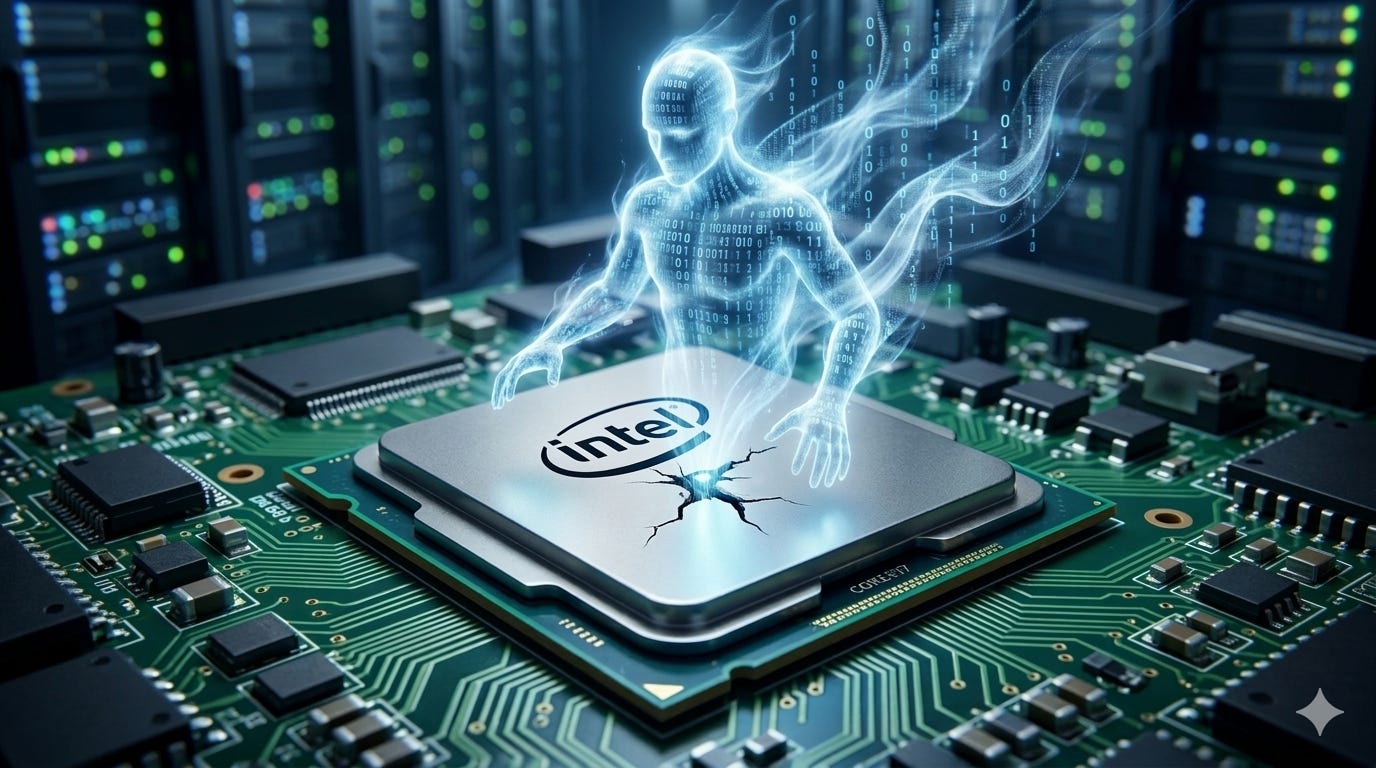
For the past 10 years of my life, I pursued a vision to secure my address. After the Equifax Data Breach, that vision morphed into securing all of my identification. What I didn’t know was the very hardware on which we were building on top of was compromised. You can read about this vulnerability below.
In the world of computing, many users believe that achieving root access—often called “Ring 0” in kernel terms—grants ultimate control over a system. It’s seen as God mode, where you can dictate every aspect of the machine’s behavior. But for those delving deeper into hardware architecture, true power resides even further below, in what’s colloquially known as Ring -3. This is the domain of the Intel Management Engine (ME), a separate, invisible processor embedded within Intel CPUs, running its own closed-source operating system—typically a variant of MINIX. This subsystem operates independently, and its implications for security and privacy are profound.
The ME doesn’t care about your system’s power state. As long as the power cable is plugged in, it’s active, even if your PC is ostensibly “off.” It bypasses your operating system’s safeguards, whether you’re using full-disk encryption like AES-256 or a hardened Linux distribution. This “ghost in the silicon” has its own network stack, allowing it to send and receive data while evading OS-level firewalls. It can access your RAM, monitor your screen, and intercept every keystroke before your OS processes them. In essence, it’s a parallel computing environment that you, as the user, have little to no visibility into or control over.
The NSA’s Role and the “Kill Switch” Irony
One of the most intriguing aspects of the Intel ME is its connection to government agencies, particularly the U.S. National Security Agency (NSA). The HAP (High Assurance Platform) bit, a feature that allows partial disabling of the ME, was reportedly implemented at the NSA’s request. 1 This “kill switch” was designed for high-security environments where even the NSA didn’t trust a black-box OS embedded in their hardware. Intel has confirmed the existence of this disable mechanism, which halts the ME after initialization on supported systems (typically Skylake or newer).
The irony is stark: an agency known for surveillance capabilities sought a way to opt out of potential backdoors in their own machines. Researchers discovered this HAP bit while exploring ME firmware, highlighting its origins in meeting government needs. However, enabling it isn’t straightforward for average users, and it’s often combined with tools like me_cleaner to remove unnecessary modules while keeping essential ones (such as BUP/ROMP) intact to prevent system instability.
Modern Vulnerabilities: A Persistent Threat
Far from being a relic of past designs, the Intel ME continues to reveal flaws. In 2025, CVE-2025-20037 emerged as a critical vulnerability—a time-of-check-to-time-of-use (TOCTOU) race condition in the Converged Security and Management Engine (CSME) firmware. This bug affects firmware versions prior to 16.1.38.2676 and 14.1.77.2497, potentially allowing a privileged user to escalate privileges via local access. Intel released updates under advisory INTEL-SA-01280 to mitigate this and related issues. Classified under CWE-367, it’s not just a bug but an architectural blind spot that underscores the risks of unauditable hardware subsystems.
This isn’t isolated; historical vulnerabilities like CVE-2017-5689 (authentication bypass in Intel Active Management Technology) and CVE-2017-5705 to CVE-2017-5712 have allowed arbitrary code execution with ME privileges. These flaws highlight how the ME’s isolation can become a double-edged sword, turning a management tool into a vector for attacks.
Community Discussions: Forums and the Quest for Transparency
The security community has long debated the Intel ME on platforms like Reddit and X (formerly Twitter). On Reddit, users express concerns that the ME could be intentionally riddled with backdoors, indistinguishable from genuine vulnerabilities. Discussions often revolve around its potential as spyware, with threads questioning whether it affects Linux users and how to mitigate it—such as avoiding vPro-equipped machines or using me_cleaner. One user noted that the ME can monitor all activity, including encrypted files, emphasizing its access to hardware-level data.
On X, similar sentiments echo. Posts describe the ME as a security vulnerability and potential backdoor, with users warning about its persistence even when the system is off. Others link it to broader concerns, like intentional chip vulnerabilities for exploitation, or reference older discoveries of processor backdoors. These conversations underscore a growing distrust: even if not deliberately malicious, the ME’s closed nature invites exploitation.
Challenges in Neutering the Beast
Attempting to remove the ME firmware outright triggers a hardcoded failsafe—your computer will shut down every 30 minutes. Tools like me_cleaner offer a workaround by stripping non-essential modules, enabling the HAP bit, and leaving just enough code to avoid panic modes. However, this isn’t foolproof and requires technical expertise. For those seeking alternatives, open-source firmware like Coreboot is sometimes mentioned, though it’s more geared toward specific hardware enthusiasts.
Rethinking Digital Sovereignty
We architect secure systems—firewalls, encryption, hardened kernels—but we’re building atop a foundation we can’t fully audit. The Intel ME exemplifies this: a subsystem that’s always on, network-capable, and opaque. Digital sovereignty remains an ideal, but until users control the hardware below the BIOS level, privacy is essentially rented. As vulnerabilities like CVE-2025-20037 remind us, the real threats often lurk in the silicon shadows. For those concerned, exploring ME-cleaning tools or ME-disabled hardware (where available) is a start, but broader transparency from chipmakers is the ultimate need.
~Sources
https://www.reddit.com/r/privacy/s/opekrZofKZ
https://hothardware.com/news/researchers-figured-out-how-to-turn-off-intel-management-engine-11-thanks-to-nsa
https://en.wikipedia.org/wiki/Intel_Management_Engine
https://blog.trackflaw.com/en/the-mysterious-story-of-a-disturbing-intel-flea/
https://forums.puri.sm/t/is-the-intel-me-nsa-b-door-fully-disabled-on-all-devices/27569?page=3
https://hardforum.com/threads/how-to-disable-intel-me-courtesy-of-the-nsa.1942882/
https://discuss.privacyguides.net/t/is-disabling-ime-using-hap-bit-ideal-why-would-the-u-s-require-it/23275
https://github.com/corna/me_cleaner/wiki/HAP-AltMeDisable-bit
https://medium.com/@Flavoured/the-intel-backdoor-nobody-can-remove-not-even-you-96592d4c7982
https://hackaday.com/2017/12/11/what-you-need-to-know-about-the-intel-management-engine/
https://zeropath.com/blog/cve-2025-20037-intel-csme-race-condition-summary
https://nvd.nist.gov/vuln/detail/CVE-2025-20037
https://www.intel.com/content/www/us/en/security-center/advisory/intel-sa-01280.html
https://feedly.com/cve/CVE-2025-20037
https://www.reddit.com/r/privacy/s/C4MBQAC5eU